
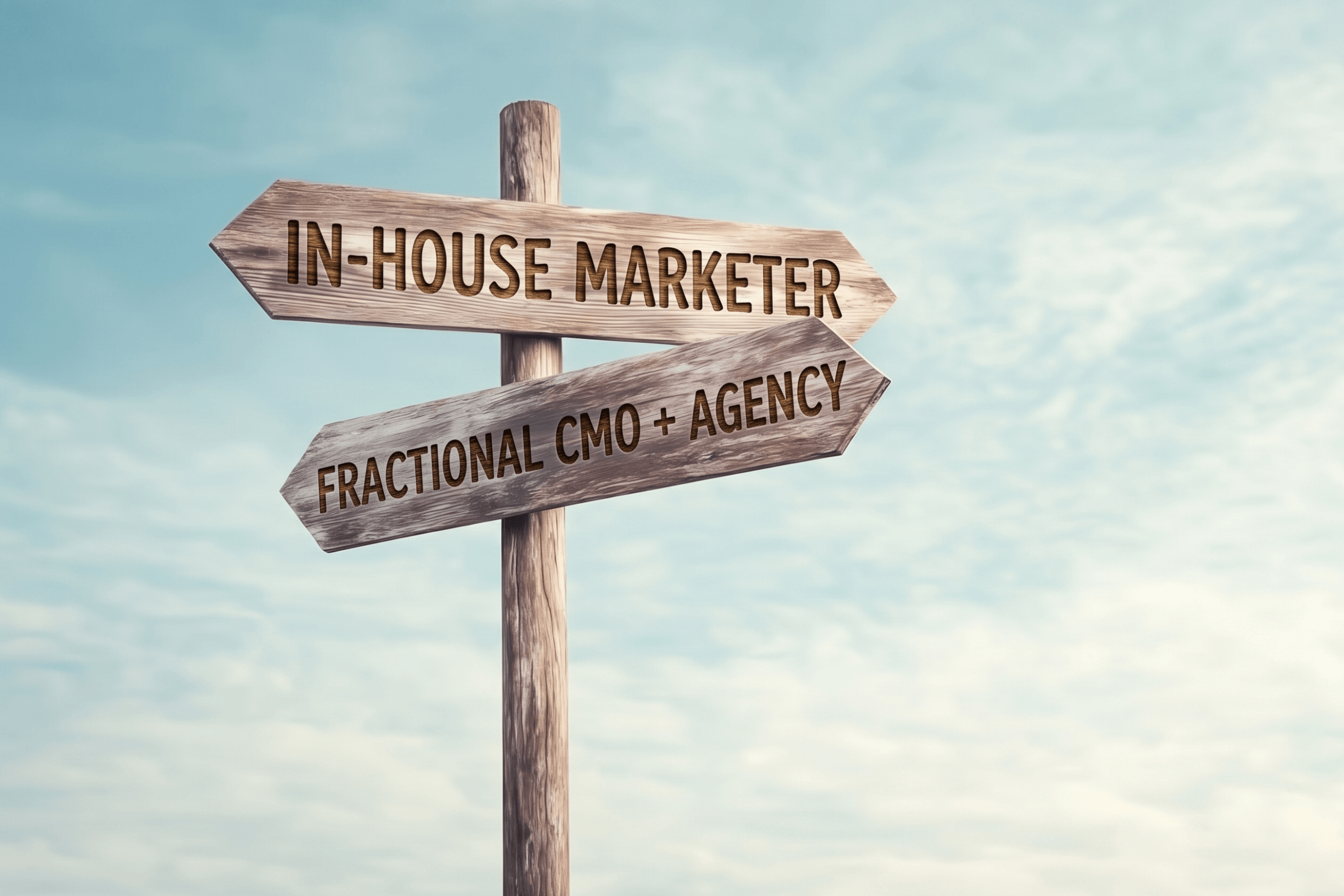
Two different answers to the same question, and why AI is changing what each one takes.
Marketing is going through one of the biggest structural changes in its history.
The internet changed how businesses reached customers. The smartphone changed when and where those customers could be reached. Social media changed who could create and distribute content.
Artificial intelligence is different.
AI isn’t simply another marketing channel or platform to add to the mix. It is beginning to change how the work itself gets done.
Research. Strategy. Content. Search. Advertising. Analytics. Design. Video. Personalization. Automation. Reporting. Customer communication. AI can increasingly accelerate tasks that once required hours, teams, or specialized resources.
Stanford University’s 2026 AI Index reports that generative AI reached 53% population adoption within just three years, faster than either the personal computer or the internet. AI is already being used in at least one business function at 88% of surveyed organizations, up from 78% the year before.
But there is an important distinction between using AI and knowing what to do with it.
That may be one of the biggest marketing challenges businesses face over the next several years. AI can help a company produce more content. It cannot tell leadership whether that content supports the right business objective.
AI can generate 50 campaign ideas. It cannot inherently know which one reflects your brand, fits your market, deserves your budget, or supports where the business wants to go.
It can make marketing dramatically faster, but It doesn’t automatically make marketing smarter.
Which brings us to a question growing businesses were already wrestling with:
What should our marketing organization actually look like?
Do you hire an in-house marketer? Or bring in a fractional CMO and agency team to run marketing for you?
The answer matters even more today because AI is changing what each of those models is capable of doing.
First, Understand What AI Is Changing
As AI makes the actual production of marketing faster and easier, the harder and more valuable questions become: What should we create? Who are we trying to reach? Which channels deserve investment? What should we automate? And what should we stop doing?
Those are leadership questions.
AI can give a good marketing strategy more horsepower. It can also help a mediocre strategy move faster in the wrong direction.
That’s where the traditional marketing staffing question gets interesting.
That’s where the traditional marketing staffing question gets interesting.
The In-House Marketer
This is the one person on your payroll who owns “marketing,” full stop. Social posts, email newsletters, website updates, the tradeshow flyer, and whatever needs doing that week.
Picture a one-person band: guitar on the back, harmonica on a neck brace, a kick drum pedal strapped to one foot. It’s genuinely impressive that it works at all, and for a while, it can.
The upside is real. An in-house hire knows your business inside and out, because they live in it every day. They’re available, invested, and, at least starting out, the least expensive option on this list.
A good marketer can use AI to accelerate research, brainstorm content, analyze information, repurpose materials, automate repetitive tasks, and dramatically expand what one person can accomplish.
That’s a real advantage.
But AI doesn’t suddenly give one person ten years of brand strategy experience, media expertise, UX knowledge, creative direction, analytics experience, SEO expertise, or executive-level decision-making ability.
The strain shows up when the setlist gets more complicated.
Say you need a rebrand, a paid ad campaign, CRM automation, and a product launch, all in the same quarter. That one-person band was never going to play lead guitar, run the sound board, and sell merch at the door at the same time. When someone is drowning in day-to-day execution, strategy is the first thing to drop.
Best for: early-stage businesses with a steady, focused workload, like keeping the website current and posting consistently, not businesses juggling five priorities at once.
The Fractional CMO + Agency
This model brings senior marketing leadership and hands-on execution together under one team, closer to a full studio session with a creative director who also sets the direction, rather than buying a strategist and a production crew separately.
Strategy. Positioning. Marketing priorities. Budgets. Team structure. Vendor management. Measurement. Creative direction. Technology decisions. And the specialists, designers, media buyers, developers, copywriters, needed to build what that direction calls for.
Need a rebrand, a website, a paid campaign, video, and a media buy? A team built this way can set the strategy behind all of it and assemble the people who execute each piece.
If AI makes producing marketing easier, what exactly are you paying for?
The answer shouldn’t simply be “more stuff.”
It should be expertise, creativity, interpretation, and the judgment to apply these tools intelligently, and just as important, the strategic leadership to decide what’s worth building in the first place.
That second part is where execution-only partners tend to fall short. Most are organized around deliverables: a website, a campaign, social content, SEO, paid media, a rebrand. What they’re not always built to do is sit above all of it and ask whether those individual activities are adding up to something.
Are we fixing the actual problem or simply executing another tactic?
That type of question requires someone looking across the entire marketing system, someone deciding how business objectives translate into marketing objectives, where AI creates meaningful leverage, where human judgment still matters most, and how internal employees, technology, data, media, creative resources, and AI tools should work together.
That’s increasingly the job.
It’s also where strategy alone falls short without the team to build it. A lot of fractional leadership works this way: excellent at developing a roadmap, but dividing a handful of hours a week across multiple clients with no one positioned to actually execute what they recommend. A brilliant strategy sitting in a shared drive doesn’t move a business forward.
So the better question isn’t simply Do we need a fractional CMO, or do we need an agency.
It’s: What combination of leadership and execution gives us the strongest marketing capability for our investment?
Best for: businesses that need both senior strategic direction and the hands-on execution to act on it, whether that’s a clearly defined initiative, unanswered questions about where marketing dollars should go, or both at once.
The New Marketing Department May Be a Hybrid
For many growing businesses, the answer may no longer fit neatly into one column.
You might have an internal marketing coordinator who understands the company and keeps initiatives moving day-to-day.
A fractional CMO + agency partner can layer senior strategic direction on top of that: setting priorities, allocating budgets, analyzing performance, and bringing in the design, development, SEO, media, video, or other specialized disciplines needed to execute it, all under one team.
And AI can sit across the entire system, helping each of those people research faster, create more efficiently, automate repetitive work, interpret information, and increase their capacity.
Think of the model as:
Human judgment + business knowledge + AI leverage + specialist execution.
That can be a very powerful marketing department. And it doesn’t necessarily require putting an entire marketing department on the payroll.
Matching the Model to Your Business
The answer comes back to what problem you’re trying to solve.
If the primary issue is getting everyday marketing tasks done consistently, an internal marketer may be exactly what you need.
If plenty of marketing activity is already happening but nobody is confidently answering why, where, how much, what’s working, and what comes next, or if you have initiatives that need capabilities you don’t have internally, the missing piece is likely leadership paired with execution.
And sometimes the smartest answer is both working together. But more capability doesn’t automatically create more clarity; only intentional leadership does.
Where Concept4 Fits In
Truth is, most businesses don’t need to plant a flag in one column and live there forever. They need direction, and the hands to carry it out, without standing up an entire department to get it.
That’s the gap we built Concept4 to close. We’re a lean team of seasoned experts who behave like an in-house CMO, one who thinks and does. We’re not a solo consultant who hands you a plan and moves on to the next client, and we’re not a big agency that shuffles you between account managers. The differentiator isn’t just what we do. It’s how we do it: tailored, goal-anchored, honest, and relationship-driven.
Not sure what your marketing organization should look like? Let’s talk.
______
Sources and Additional Reading